
GEO Positioning System · GPS
See how AI describes your brand. Give your decisions a firmer basis.
GEO Positioning System (GPS) is REALI’s independently developed product for researching AI answers about brands and issues. Starting with your questions, repeated tests across models bring together answers and visible citations, highlighting differences worth checking.
Your team uses the findings to decide what information to add, what to clarify and which questions to keep tracking.
01 · Research questions
What can GPS help me understand?
Brand understanding
When asked about your brand, how does AI describe it? Which descriptions need checking?
Recommendations in context
When asked about a need or situation, which options does AI mention? Does your brand appear?
Differences and information gaps
How do the models differ? What may need a clearer explanation or more information?
Sources and change
Which citations are shown? Under comparable test conditions, do the descriptions or sources change?
02 · Findings and decisions
What decisions can the findings support?
Answers, visible citations and comparisons help your team trace a finding back to its basis. Deliverable formats and the scope of professional interpretation are agreed before the study begins.
Answers and recurring descriptions
Check whether the description is complete and accurate
Decide what to add or clarify
Citation links shown in answers
Read the source page and check its context
Prioritize pages and content for review
Differences across models and test dates
Check that questions, settings and dates are comparable
Select questions to track and arrange further tests
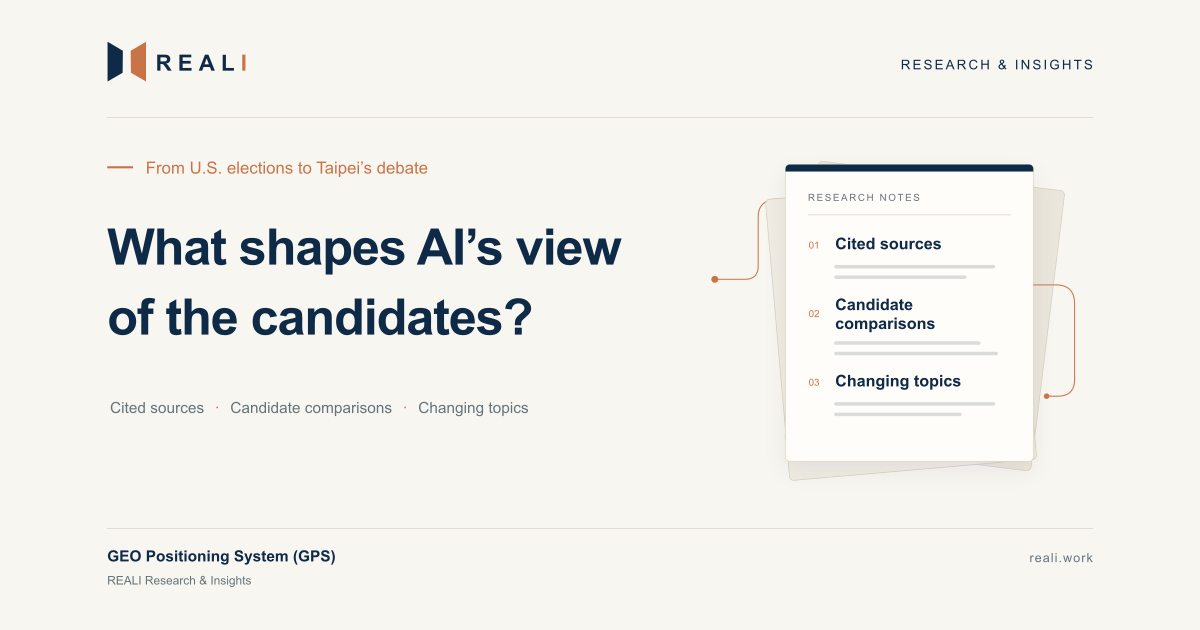
Start with a published study.
Our Taipei mayoral debate study compares AI answers, visible citations and changing topics. Its charts, research conditions and limitations let you follow the findings back to the material. It examines AI answers under specific conditions, not public opinion or candidates’ abilities.
Study period: 2026.10.30–11.01 · ChatGPT / Gemini · Raymond Wu and the REALI research team
Read the Taipei debate study and charts03 · From question to research
What do I need to provide, and how does the study work?
Start with public background on the brand or issue, the audience you care about and the decision the research should support. You do not need a complete question list. The team reviews and confirms the questions and test conditions before execution.
- 01Team confirms
Question Intelligence
Shape the questions
Explore situations and candidate questions. The team selects, edits and confirms the scope.
- 02System executes
Repeated tests across models
Run the agreed research
Retain each answer and visible citations alongside the model, questions and date.
- 03System assists
Data Intelligence
Organize answers for comparison
Compare descriptions, recurring themes and sources so the team can inspect and interpret them.
- 04People review and decide
Human Review
Check findings, then decide
Review originals and limitations before deciding what to clarify, add or track.
This describes the research work and responsibilities; it does not imply every step is fully automated. Available models, test settings and deliverables are confirmed for the engagement.
04 · Recorded operation
How do you get from a question to answers and sources?
These frames from GPS recordings show question review, run progress and source records. They come from different stages of operation, not one continuous study.
Recording source and conditions
GPS Copilot 操作(1).mp4 · 01:06
Apple demonstration. Clips were captured under different recording conditions and must not be treated as one research run or customer outcome.
Recording source and conditions
GPS Copilot 操作(1).mp4 · 02:36
Apple demonstration. Clips were captured under different recording conditions and must not be treated as one research run or customer outcome.
Recording source and conditions
GPS Copilot 操作(2).mp4 · 00:10
Apple demonstration. Clips were captured under different recording conditions and must not be treated as one research run or customer outcome.
Recording source and conditions
GPS 完整操作結果-Apple為範例.mp4 · 01:55
Apple demonstration. Clips were captured under different recording conditions and must not be treated as one research run or customer outcome.
05 · Organizing the research
What does GPS add to asking AI yourself?
A single question can provide a useful lead. Team decisions also need consistent questions, repeated observations, source records and a clear handover. GPS brings those research tasks together.
Research objective
Agree what you need to understand, so the answers can be compared meaningfully.
Tests and records
Compare repeated answers across models, with visible citations and test conditions.
Interpretation and handover
Help colleagues understand the findings, inspect their basis and decide what to do next.
06 · Human judgment
What does the system do, and what do people decide?
GPS helps organize large sets of answers. Whether the information is correct, a difference matters, or action is needed still calls for human experience and professional judgment.
Make repeated work dependable
Run tests · Organize answers · Support comparison
Put professional judgment to work
Understand context · Verify evidence · Decide action
07 · Research and monitoring
Research the differences. Then follow the questions that matter.
Research first helps us understand how AI answers. Professionals then select questions for regular observation. Retesting shows whether answers and sources change, read alongside the model, date and settings.
Research: understand the question
Explore answers, sources and differences to build a basis for interpretation.
Monitoring: keep watching
Retest an agreed question set on an agreed schedule to see which changes deserve attention.
08 · Research and data
How do we check the research and agree how data is used?
A traceable basis
Read the questions, models, dates and visible citations alongside each finding. People still need to check whether the original sources support the conclusion.
An agreed data scope
Protection of research data is part of GPS’s design considerations. Data use and publication are subject to authorization and the service agreement; available capabilities follow the confirmed service scope.
Data security and factual accuracy are different concerns. Security design does not replace fact-checking or guarantee zero risk. The website privacy notice covers website interactions, not the full data terms of a GPS engagement.
09 · Your next step
Will your team use the system, or would you like research support?
Read a published study to see the output. Discuss a project if you have a specific question, or system use if your team wants to run research. How often you research and who operates the system are separate choices.